


If you've ever wondered how Castell keys work, the short answer is that a Castell key can only be removed from a lock, switch or exchange unit when it's safe to do so, and it can only be inserted somewhere else in exactly the order your safety sequence demands. That single mechanical rule is what lets a Castell trapped-key interlocking system guarantee that a guard door, valve or electrical panel is only accessible under safe conditions, with no software and no power supply involved, just a key that physically can't go anywhere it shouldn't.
What is a Castell trapped-key interlock?
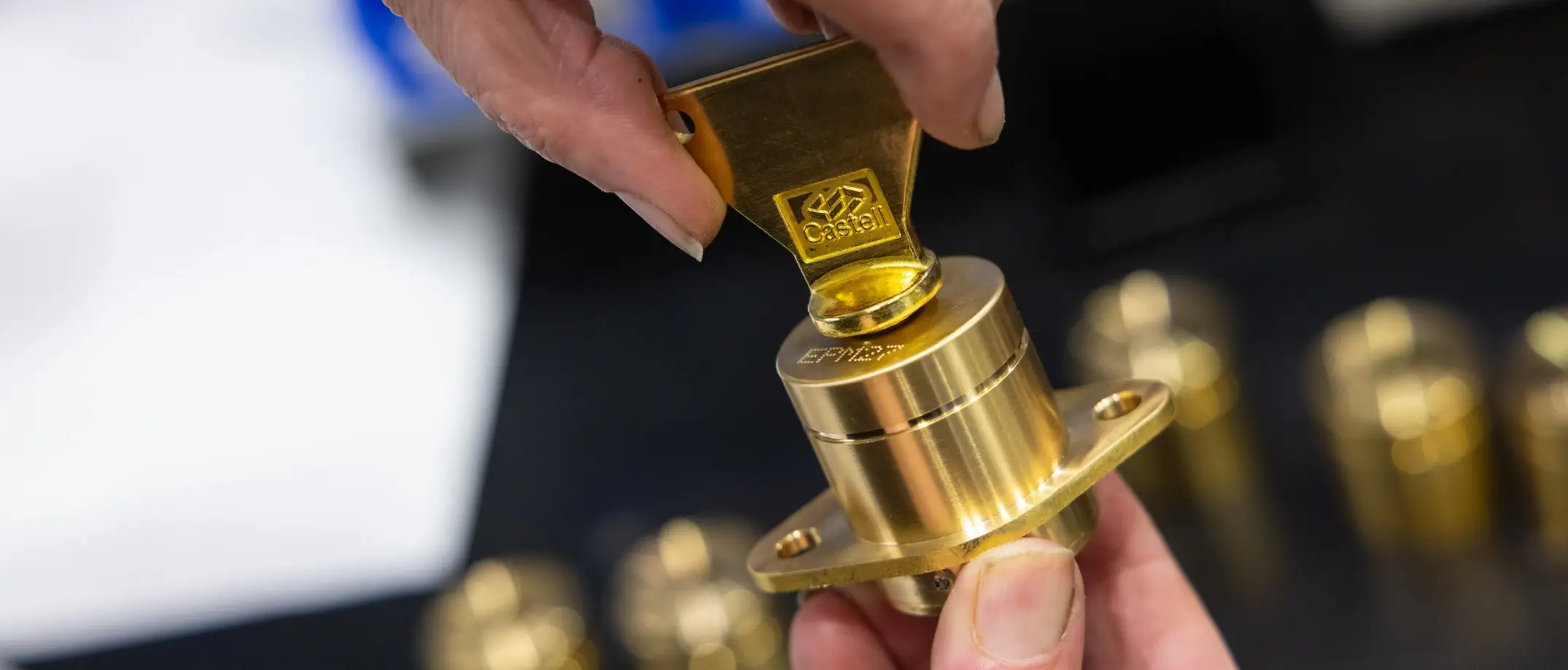
A trapped-key interlock is a mechanical safety system built from three kinds of component: interlock bodies fitted to the guard, valve or switch you want to protect; key exchange units that hold and release keys in a fixed sequence; and the keys themselves, each cut to fit only its own family of locks. Because a key is a physical object that can only be in one place at a time, the system forces operators through the correct sequence of actions whether they mean to or not.
Pneutrol Spares stocks the full Castell range for concrete batching plants, covering mechanical access interlocks, electrical switch interlocks, key exchange units and valve interlocks for safe-area, hazardous-area and intrinsically safe applications.
How a trapped key actually works
Inside every Castell lock is a spring-loaded bolt that engages a groove cut into the key. As long as the equipment the lock protects is switched on or running, that bolt holds the key trapped in the barrel; it cannot be forced out without damaging the unit. Only when the equipment is turned off or isolated does the bolt release, freeing the key to be taken elsewhere.
That freed key can then be inserted into a second lock, typically an access door or a safety gate, where turning it traps it in place there instead. This is what safely keeps that door unlocked for maintenance: the machinery cannot be switched back on until the key is returned, and the key cannot be returned until the door is securely closed and locked again.
The key exchange sequence, step by step
Larger systems chain several interlocks together through a Castell key exchange unit so that one action physically enables the next:
- Isolate the equipment. The operator switches off or closes the machine, valve or panel being protected, which frees its own access-lock key.
- Trap that key in the exchange box. Inserting the freed key into a B, W, X, Y or Z-type exchange unit locks it in place; it cannot be removed again until the whole sequence is reversed.
- Take the released key. Trapping the first key mechanically releases a second (or third) key from the same unit, the one needed to open the guard door, unlock the valve, or access the panel.
- Do the work. With the equipment physically locked out and the correct key in hand, the operator can safely open the guard or carry out maintenance.
- Reset in reverse. Returning the released key to the exchange unit frees the original access-lock key again, and only then can the equipment be restarted.
Tip: because each step is enforced mechanically, there's no way to skip ahead. Even a determined operator physically cannot free a key out of sequence without damaging the lock.
Types of Castell keys
Castell keys aren't interchangeable: the lock portion type (F-style or Q-style) and the key's material and finish all have to match the interlock body it's paired with. Pneutrol Spares stocks the standard range:
| Key | Type | Typical use |
|---|---|---|
| QS-S / QS-NI / QS-B | Q-style, stainless / nickel-plated / brass | General Q-type interlock bodies and exchange units, chosen by environment |
| FK4-NI | F-style, nickel-plated | Standard figure-style lock portions on access interlocks |
| FK4-MASTER | F-style master key | Overrides a set of FK4 locks for authorised maintenance access |
| FKW6-S / FKW6-NI | Sealing keys, stainless / nickel | Wear-resistant sealing applications on the F-range |
| KSD-R | Switch disconnector key | Pairs with Castell electrical switch interlocks to lock out isolators |
| FLIP-S | Protective cap | Shields an unused lock portion or spare key position from dirt and damage |
Where Castell keys are used, on batching plants and beyond
On a concrete batching plant, trapped-key systems typically guard silo and hopper access doors so they can't be opened while agitators or discharge gates are live; valve interlocks on pneumatic or process lines so a line can't be opened while pressurised; and electrical switchgear so a panel can't be energised while someone is working inside a guarded area. The same principle is used far more widely across industry: isolating high-voltage transformers and circuit breakers before anyone touches live components, and securing access doors on robotic cells, production lines and other heavy rotating equipment. Chaining the relevant mechanical, electrical and valve interlocks together through shared exchange units builds a full permit-to-work sequence without relying on a single point of electronic failure.
Choosing the right Castell key for your system
Because the lock portion, material and even the individual key cut are specific to your installed interlocks, the safest way to order a replacement or spare key is by matching the part number already fitted to your Castell hardware, or by quoting the datasheet reference stamped on the existing key. Mixing F-range and Q-range components, or fitting a brass key where a sealed stainless one is specified, will stop the sequence working as designed.
Frequently asked questions
Can a Castell key be removed at any time?
No. A Castell key is mechanically trapped in its lock or exchange unit until the equipment it protects is in the safe state the sequence requires. It cannot be forced out without damaging the mechanism.
What's the difference between F-type and Q-type Castell keys?
They're two different lock portion families with different key profiles. An F-range key only fits F-style (figure) lock portions, and a Q-range key only fits Q-style ones; the two aren't interchangeable.
What is a Castell key exchange unit for?
It's the component that links interlocks together: trapping one key inside it releases another, so the operator is physically forced through your intended safety sequence step by step.
Do Castell interlocks need power to work?
Mechanical access and valve interlocks don't; the safety logic is built into the key and lock geometry itself. Electrical switch interlocks add a switched contact on top of the same mechanical trapping principle.
Who invented the trapped-key interlock?
The principle dates back to 1922, when James Harry Castell developed it to protect workers during the rollout of London's electrical grid. The same mechanical logic behind those original switchgear interlocks still underpins the Castell range today.
Need a replacement key or a new interlock sequence designed? Browse our full range of Castell trapped-key interlocking systems, or see the Castell Keys range directly.